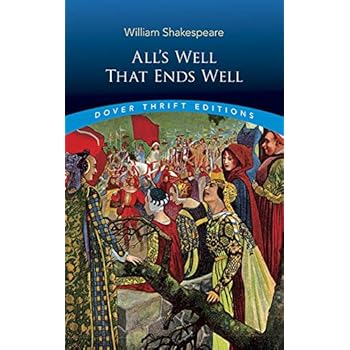
All's Well That Ends Well (Dover Thrift Editions)
Category: Books,Arts & Photography,Performing Arts
All's Well That Ends Well (Dover Thrift Editions) Details
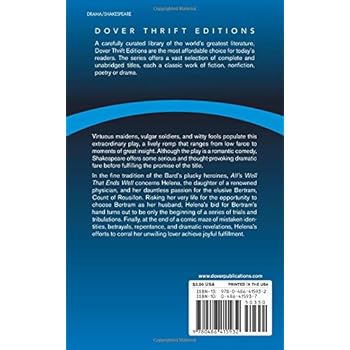
From the Back Cover Virtuous maidens, vulgar soldiers, and witty fools populate this extraordinary play, a lively romp that ranges from low farce to moments of great insight. Although the play is a romantic comedy, Shakespeare offers some serious and thought-provoking dramatic fare before fulfilling the promise of the title. In the fine tradition of the Bard's plucky heroines, All's Well That Ends Well concerns Helena, the daughter of a renowned physician, and her dauntless passion for the elusive Bertram, Count of Rousillon. Risking her very life for the opportunity to choose Bertram as her husband, Helena's bid for Bertram's hand turns out to be only the beginning of a series of trials and tribulations. Finally, at the end of a comic maze of mistaken identities, betrayals, repentance, and dramatic revelations, Helena's efforts to corral her unwilling lover achieve joyful fulfillment. Read more About the Author "He was not of an age, but for all time," declared Ben Jonson of his contemporary William Shakespeare (1564–1616). Jonson's praise is especially prescient, since at the turn of the 17th century Shakespeare was but one of many popular London playwrights and none of his dramas were printed in his lifetime. The reason so many of his works survive is because two of his actor friends, with the assistance of Jonson, assembled and published the First Folio edition of 1623. Read more


Reviews
In rating this book three stars, I'm comparing it to other Shakespearean plays; compared to the general run of books available, it would probably rate five stars, and certainly at least four. But it's not in the top bracket of Shakespeare's comedies; it's flaws are nothing unique to itself, but are simply the problems inherent in many of his comedies, more noticeable here than in some others.The biggest problem I have with this story is that I simply cannot watch it or read it without becoming overly focussed on the question, "What in the world does she see in him?" Helena goes to great lengths to gain Bertram as a husband; we never see what, exactly, he has done to earn her attraction, but surely, whatever it is can't possibly justify maintaining that interest after he demonstrates conclusively that he is a lying, arrogant, philandering scum with no consideration at all for meeting his responsibilities like a man. Why in the world would any woman smart enough to trap such a man with the traps she sets WANT him?I've always had issues with Shakespeare's concept of romantic love; this play is not the worst in that regard, but it's far from the best.