Holbein's "Ambassadors": Making and Meaning (National Gallery London Publications)
Category: Books,Arts & Photography,History & Criticism
Holbein's "Ambassadors": Making and Meaning (National Gallery London Publications) Details
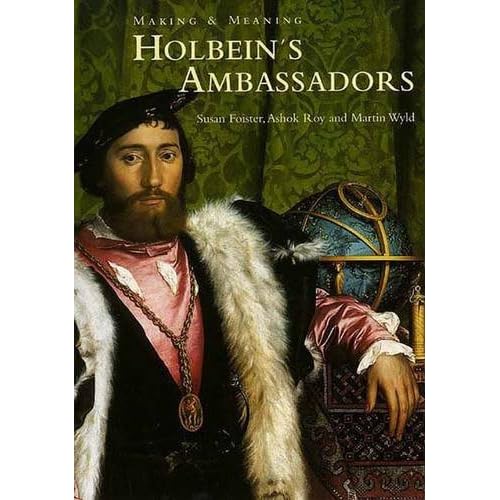
A study of Holbein's portrait entitled "The Ambassadors". It offers a technical account of the painting and sets it in the context of the religious and political crisis in Europe in 1533, investigating the political fortunes and artistic patronage of the Dinteville family who commissioned it. Read more


Reviews
I've always been fascinated by Hans Holbein the Younger whose father, the Elder ran a productive art school in Augsburg, Germany--Bavaria, actually. Hans the Younger greatly exceeded his father in importance in the history of painting. As a student of Tudor England, Holbein's being the official court portraitist for Henry VIII was both a great honor and fraught with great peril. After Queen Jane Seymour's death, Henry's proclaimed love of his life, a 5th wife was required to further provide male progeny as a back-up to Edward, the Prince of Wales. I've always thought that 1538's full-length portrait of Christina of Denmark is so lovely, despite the fact that she is portrayed in widow's weeds; she was 16 and had lost her first husband at age 13! Perhaps because she's all in black except for her lovely face and beautiful hands (for which Holbein had a particular mastery) she looks all the more fetching. However, she so disliked the thought of marrying the notoriously poor husband that she proclaimed that only if she had two heads (presumably, a spare) would she marry Henry. He being the true catch of Europe, this was a strong rejection indeed. Christina's sitting took only 3 hours, the only known period of time and quite a short one at that for Holbein, or any painter. Enter Anne of Cleves painted by Holbein within the next year or so and we see he was really caught between a rock and a hard place. It was always a question if a painter should render the subject honestly or as attractive as possible. With not just Anne but also her relatives breathing down his neck, Holbein went with "attractive" with her. Bad choice. Henry almost literally took his head off. The shock of seeing her with a huge wedding assembly, Henry, quick on his feet switched gears and greeted her: "My sister!!" They were formally married but on paper only...he couldn't bring himself to couple with the "Mare of Flanders" and she was never crowned queen. But she was the most lucky of all 6 of his queens: she received an enormous settlement for their "annulment" including her own castle and lived in luxury the rest of her days.The ambassadors from France depicted in the famous--and probably his best portrait--are Jean de Dinteville and George de Selve. In addition to the cover, the portrait or details of it are shown 14 times including the "X-radiograph" of 1984, the painting before cleaning, the messy one showing the panels after the cleaning but before the restoration and then--please be careful not to miss it!!--the full portrait after cleaning and restoration as it is installed in the National Gallery in London. (And PLEASE realize there's a big difference between the National Gallery and the National Portrait Gallery.) This full painting is shown on the back cover and is 5 1/3" wide. I would have had no clue about the final rendering in the book had I not been consulting the index. Tucked, pretty well-hidden, inside the back cover is a pullout. It shows the painting 7 1/2" wide but, most unfortunately, it's only on the right-hand page of the fold-out. As the painting is almost square, had it been spread over both of the fold-out pages, it could have been about 10" wide. But I guess they didn't want the fold line to be visible on the middle of the painting. Ah well...there are enough details highlighted inside to make up for it.The authors are quite expert in their discussion of this painting in connection with all of Holbein's work as well as other of his contemporaries and influences. I love the thorough discussion of the hidden and/or unusual elements in the painting. What the heck is the elongated skull for? Why is that crucifix peeking out from behind the far left curtain? What is the significance of the clothing, the floor, the items on the table?Of particular interest to me, loving the study of textiles and embroidery of Tudor times is the embroidery and the oriental carpet. There are no extant carpets from those days but quite a bit because of Holbein's attention to detail do we see just how popular and prevalent were such carpets after trade with the East was opened up. And his detail extends to the gold and silver work on embroidered clothing--real metal threads--that the blackwork or double running stitch so popular on the garb of the ultra-rich of the day is fondly nicknamed the Holbein stitch, even today.I have many books on Holbein and this is one of my favorites because it focuses on this one painting. It'll really be worth your time if you would like insights into these details as well.